Category: Uncategorized

  • China Tariffs in 2026: How US Importers Are Restructuring Their Supplier Base

    China Tariffs in 2026: How US Importers Are Restructuring Their Supplier Base

    “China tariffs” is one of the fastest-rising searches in the United States this year, and for good reason. Duty rates on Chinese goods have changed several times since 2018, new measures are announced with little warning, and the low-value shipment exemption that many e-commerce sellers relied on was closed for goods from China in 2025. For importers, the question is no longer whether tariffs will move, but how to buy in a way that survives the next move.

    This guide explains what experienced US buyers are doing in 2026, step by step. It is written by our Hong Kong procurement team, which verifies suppliers and follows production in China and across Asia for international companies.

    1. Map your real tariff exposure, product by product

    Most companies know their total duty bill but not where it comes from. Start with a simple table: every product you import, its HTS code, its country of origin, the duty layers that apply to it today (the general rate, Section 301 duties on Chinese goods and any additional measures), and its yearly volume.

    • Confirm each HTS code with your customs broker. A wrong classification is one of the most common and most expensive mistakes.
    • Rank products by duty paid per year. Usually a small number of items carry most of the exposure.
    • Flag the products where a change of a few percentage points would wipe out your margin.

    2. Compare landed cost, not unit price

    A factory price that is 8% lower means nothing if duties, freight, inspection and longer lead times erase the saving. Build a landed-cost model for each key product: unit price, packaging, inland transport, ocean or air freight, insurance, duties, broker fees and the cost of carrying more stock.

    Run it for your current supplier and for every alternative you consider. Many buyers discover that staying in China with a better-negotiated contract beats moving production in a hurry.

    3. Diversify carefully: China plus one, not China minus everything

    Vietnam, Thailand, Malaysia, India and Indonesia are now part of most sourcing plans. They can reduce exposure, but they come with their own risks: less mature supply chains for some categories, longer ramp-up, and quality that varies more between factories.

    • Move product lines gradually, starting with simpler items.
    • Keep your best Chinese suppliers as a benchmark and a backup.
    • Check rules of origin. US Customs looks closely at goods that are only assembled or relabeled in a third country. If the product is not substantially transformed there, it can still be treated as Chinese, with penalties for misdeclaration.

    4. Verify every new supplier before the first payment

    Rushing to a new country with an unverified factory is how tariff savings turn into losses. Before you pay a deposit, check the business license, confirm the factory actually makes your product (and is not a trading company presenting itself as a factory), visit or audit the site, and approve a production-grade sample.

    5. Put tariffs into your contracts

    Tariff clauses are now standard in serious sourcing contracts:

    • Incoterms that match your control. FOB keeps freight and customs on your side; DDP shifts them to the supplier but hides costs inside the price.
    • Price adjustment and tariff-sharing clauses that say who absorbs a new duty and from which shipment date.
    • Shorter price validity and volume bands instead of fixed annual prices.
    • Exit and transfer rights for your molds and tooling, so you can move production if you need to.

    6. Time your purchases, but do not gamble

    Some importers pull orders forward before an announced increase. It can work, but it ties up cash and warehouse space. Decide with your landed-cost model, not with headlines.

    How Golden Leverage helps

    From our Hong Kong office we help US importers benchmark their current Chinese suppliers, verify alternative factories in China and Southeast Asia, negotiate tariff-aware contracts and follow production until shipment. If you are reviewing your supplier base this year, start with our Sourcing Starter Pack: a one-time supplier verification and price benchmark before you commit money. Or simply tell us what you import and we will reply with the next steps.

    Tariff rates change frequently. Always confirm the duty applicable to your HTS code with a licensed customs broker before you order.
  • Tariff Volatility in 2026: How to Structure Sourcing Contracts for Unpredictable Trade Policy

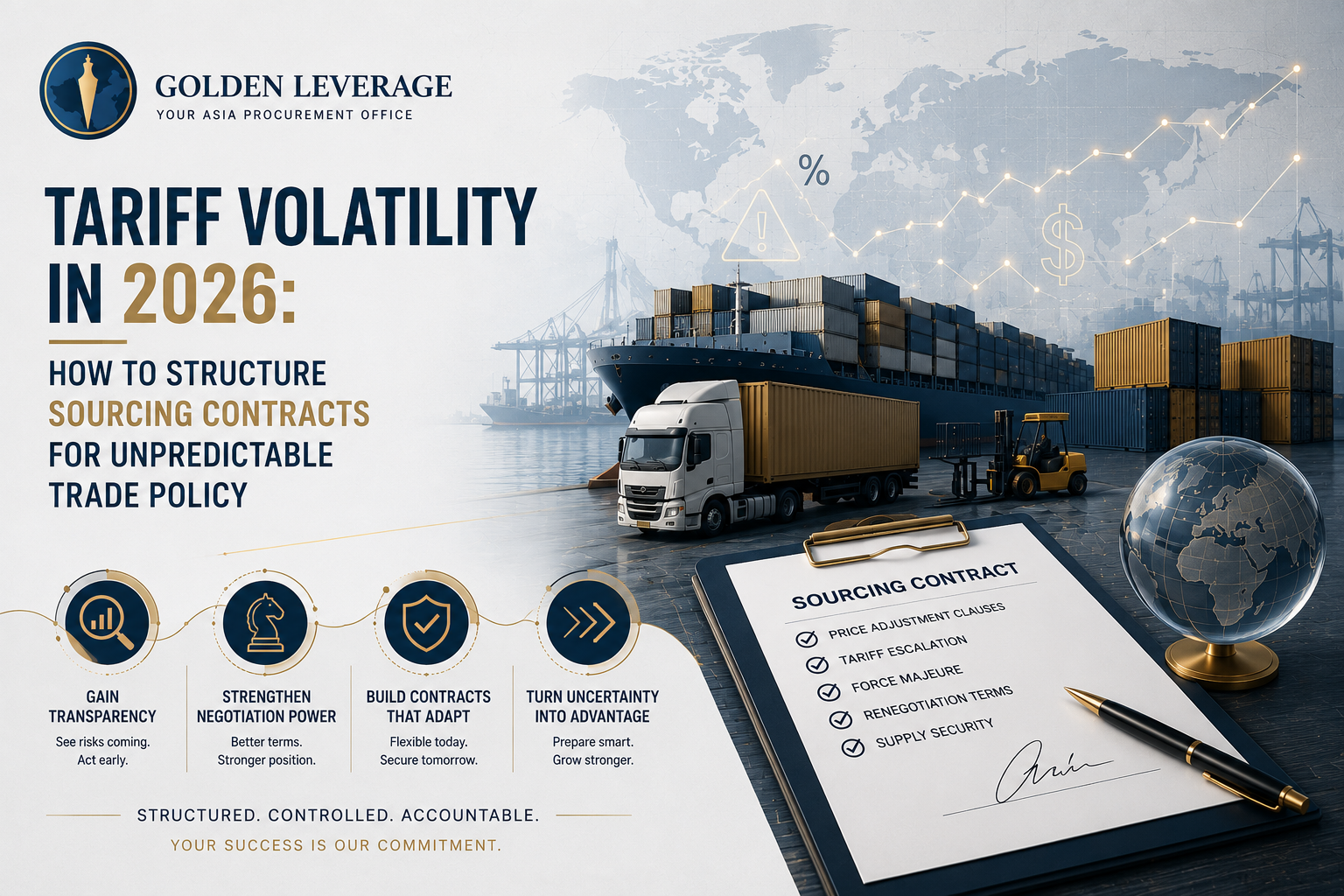
    Tariff Volatility in 2026: How to Structure Sourcing Contracts for Unpredictable Trade Policy

    Tariff volatility has become one of the defining risk factors in global sourcing. For much of the past decade, procurement organizations treated trade policy as a matter for legal and compliance teams to monitor in the background, reviewed on an annual basis at most. That assumption no longer holds. Entering 2026, tariff volatility ranks as the leading regulatory concern among trade and procurement professionals worldwide, and organizations still operating under rigid, single-region sourcing contracts are absorbing the greatest financial exposure as a result.

    Tariff Volatility Has Become an Operational Reality, Not a Policy Footnote

    The scale of this shift is well documented. Recent industry research shows trade professionals now identifying tariff volatility as their most significant regulatory risk, a substantial increase from prior years. What was once an annual policy review has become a live operational variable, one capable of altering the landed cost of a shipment in the interval between order placement and customs clearance.

    For companies sourcing from Asia, this creates a specific structural problem. The supplier relationship may be sound, the factory reliable, and the product specification correct — yet the underlying contract framework was built for a more stable trade environment than the one businesses now operate in.

    Why Conventional Annual Contracts No Longer Provide Adequate Protection

    Traditional procurement contracts are typically structured around annual pricing cycles: a rate is negotiated, fixed for twelve months, and revisited the following year. This model assumes that trade costs move gradually and predictably. Under current conditions, that assumption is no longer reliable. Tariff schedules can change with limited notice, product classifications can be reinterpreted, and a country’s preferential trade status can shift with little warning.

    Organizations that continue to rely on fixed annual agreements are typically left with two unfavorable outcomes when this occurs: absorb the resulting margin loss, or enter renegotiations from a position of weakness with a supplier who understands the buyer has no contingency in place. Neither outcome serves the long-term interests of the business.

    Five Principles for Structuring Sourcing Contracts Around Tariff Volatility

    Organizations that are managing tariff volatility in sourcing contracts effectively tend to apply a consistent set of disciplines. None require complex tooling, but each requires sustained procurement governance:

    1. Build cost-adjustment mechanisms directly into the contract. Rather than committing to a single fixed price, well-structured agreements now include provisions that account for duty changes cost-sharing formulas, defined price-review triggers, or renegotiation windows tied to specific regulatory events rather than a fixed calendar date.

    2. Qualify a secondary supplier in advance of need. Supplier diversification is only effective when completed proactively. A validated alternative supplier in a different country or region — even one used infrequently converts a sudden tariff change from a crisis into a manageable adjustment.

    3. Separate sourcing decisions from customs classification decisions. A common and costly gap in procurement practice is pricing a product without fully verifying its customs classification and country-of-origin documentation. Resolving this before committing to volume prevents unexpected duty liabilities from surfacing after goods have shipped.

    4. Monitor tariff exposure by product category, not solely by supplier. Tariff risk tends to concentrate around specific materials or product categories rather than individual factories. Tracking exposure at the category level provides significantly clearer visibility into which parts of the supply chain carry genuine risk.

    5. Maintain independent production oversight, separate from commercial negotiation. When the same personnel responsible for price negotiation are also solely responsible for verifying production quality and compliance, issues are more likely to go undetected. Independent supervision and inspection identify problems — and cost drift before they reach the final invoice.

    A Broader Shift: From Lowest-Cost Sourcing to Structured Resilience

    These practices reflect a broader transformation in procurement strategy for 2026. Cost remains an important factor, but it is no longer the sole determinant of sourcing success. Leading organizations are deliberately building redundancy into their supply chains distributing production across two regions, maintaining modest buffer inventory for critical components, and treating supplier verification as an ongoing discipline rather than a one-time step prior to the first purchase order.

    This approach does not eliminate tariff risk; no strategy can. It does, however, materially change the negotiating position of the buyer. An organization with a validated secondary supplier, accurate origin documentation, and a contract structured to accommodate policy change negotiates from a position of strength. An organization without these elements negotiates from exposure.

    Implications for Procurement Leadership

    Trade policy volatility is unlikely to diminish in 2026. The appropriate response is not an attempt to forecast every regulatory change — a task no organization can reliably accomplish but rather the construction of sourcing frameworks resilient enough to absorb change without disruption to operations or margin. This requires rigorous supplier validation, contracts designed for a volatile trade environment, and production oversight capable of identifying issues early in the process rather than after shipment.

    This is the core function a procurement execution office is designed to deliver: not simply supplier identification, but the structural controls surrounding that relationship ensuring that a policy shift originating on the other side of the world does not translate into a margin crisis at home.

    Golden Leverage is a Hong Kong–based procurement execution office supporting international companies sourcing across Asia since 2015.

  • 5 Strategic Pillars of Asian Procurement: Protecting Margins in 2026

    5 Strategic Pillars of Asian Procurement: Protecting Margins in 2026

    In the current global landscape, the “race to the bottom” on pricing has reached its limit. For international enterprises, the focus has shifted from finding the cheapest factory to securing the most resilient supply chain. At Golden Leverage, we believe that procurement is not about chasing the lowest price; it is about protecting margins through structure, supplier validation, and operational control.

    The Hidden Risks of “Online-Only” Sourcing

    Many businesses fall into the trap of using unverified online directories. While these platforms offer convenience, they lack accountability. Without a physical presence in Asia, you are exposed to several critical risks:

    • Unauthorized Sub-contracting: Your order is passed to a smaller, lower-quality workshop without your knowledge.
    • Material Substitutions: Factories cutting costs on raw materials to offset inflation, leading to product failure.
    • Compliance Gaps: Failure to meet international standards like SGS or Bureau Veritas requirements.

    “Procurement is no longer a transactional task; it is a strategic defense of your company’s bottom line.”

    The 3 Pillars of Structural Procurement

    To successfully navigate the Asian market in 2026, your Asian procurement strategy must be built on three specific pillars that ensure operational control.

    1. Rigorous Supplier Validation

    Before a single dollar is transferred, a deep-dive audit is mandatory. This includes verifying business licenses, production capacity, and historical export data to ensure the factory is actually who they claim to be.

    2. Direct Operational Control

    Communication via email is insufficient. You need “boots on the ground” to supervise production cycles and handle real-time problem-solving. This prevents small delays from turning into logistical nightmares.

    3. Accountability and Benchmarking

    By benchmarking quotations and enforcing strict quality control protocols, you eliminate the “hidden markups” often added by middlemen or agents with misaligned interests.

    Are you committing over $5,000 to a new supplier? Don’t risk your margins on a guess. Secure your investment with our Sourcing Starter Pack for a complete risk observation report and supplier validation.

    GL

    Golden Leverage Asia Limited

    Securing and structuring sourcing operations for international companies across Asia since 2015. We act as your dedicated procurement office, turning your supply chain into a competitive advantage.

  • Defeating the “Quality Fade”: How to Maintain Manufacturing Standards in Asia

    Defeating the “Quality Fade”: How to Maintain Manufacturing Standards in Asia

    It is a story common among procurement managers worldwide: the first sample was perfect, the first shipment was acceptable, but the second or third order arrives with significant defects. This isn’t usually an accident; it is a calculated industry phenomenon known as the “Quality Fade.”

    The Golden Leverage Edge: We don’t just “hope” for consistency; we enforce it. Our localized operational control keeps your factory accountable from the first unit to the last.

    The Quality Fade is the slow, deliberate reduction in material quality or manufacturing precision used by factories to secretly increase their own profit margins at your expense.

    The Three Silent Margin Killers

    Without “boots on the ground” supervising your production, factories often feel emboldened to optimize their own costs. If you aren’t physically present, you are exposed to:

    • Material Substitution: Swapping high-grade components for cheaper alternatives that look identical to the naked eye.
    • Reduced Quality Intervals: Skipping vital mid-stream inspections to increase production speed.
    • Unauthorized Sub-contracting: Your order being moved to a smaller “satellite” workshop that lacks your required compliance.

    How we solve this: Golden Leverage performs surprise on-site visits during the production cycle—not just at the end—ensuring that the materials you paid for are exactly what is used on the assembly line.

    “In the Asian manufacturing market, you don’t get what you expect; you only get what you inspect.”

    Bridging the Accountability Gap

    The biggest mistake a modern business can make is relying solely on email, video calls, or digital dashboards for quality assurance. Distance creates an “accountability gap” that is easily exploited by suppliers who know you cannot easily verify their claims.

    Golden Leverage bridges this gap. By acting as your dedicated Asia Procurement Office, we provide the physical presence required to stop quality issues before the goods are ever loaded onto a container. If the quality doesn’t meet the benchmark, the shipment does not leave the dock. We handle the difficult negotiations so your team can focus on growth.

    Protect Your Brand’s Future

    Manufacturing quality shouldn’t be a gamble. It should be a structured, predictable process involving pre-production audits and mid-stream inspections. Whether you are using our Sourcing Starter Pack to vet a new partner or our Dedicated Agent service for long-term production, Golden Leverage provides the infrastructure necessary to protect your reputation.

    Is your current supplier starting to cut corners? Stop the fade before it destroys your customer trust. Contact Golden Leverage today to schedule a specialized production audit and reclaim absolute control over your supply chain.

We use essential cookies to run this website. With your permission, we also use Google Analytics to understand how the site is used. Privacy Policy