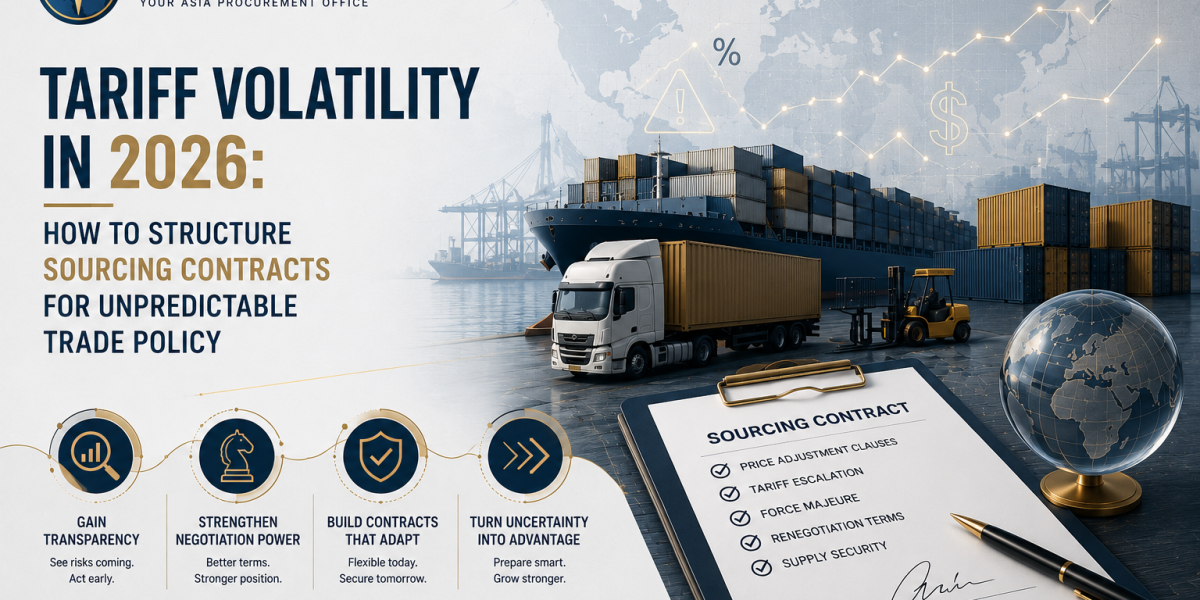
Tariff volatility has become one of the defining risk factors in global sourcing. For much of the past decade, procurement organizations treated trade policy as a matter for legal and compliance teams to monitor in the background, reviewed on an annual basis at most. That assumption no longer holds. Entering 2026, tariff volatility ranks as the leading regulatory concern among trade and procurement professionals worldwide, and organizations still operating under rigid, single-region sourcing contracts are absorbing the greatest financial exposure as a result.
Tariff Volatility Has Become an Operational Reality, Not a Policy Footnote
The scale of this shift is well documented. Recent industry research shows trade professionals now identifying tariff volatility as their most significant regulatory risk, a substantial increase from prior years. What was once an annual policy review has become a live operational variable, one capable of altering the landed cost of a shipment in the interval between order placement and customs clearance.
For companies sourcing from Asia, this creates a specific structural problem. The supplier relationship may be sound, the factory reliable, and the product specification correct — yet the underlying contract framework was built for a more stable trade environment than the one businesses now operate in.
Why Conventional Annual Contracts No Longer Provide Adequate Protection
Traditional procurement contracts are typically structured around annual pricing cycles: a rate is negotiated, fixed for twelve months, and revisited the following year. This model assumes that trade costs move gradually and predictably. Under current conditions, that assumption is no longer reliable. Tariff schedules can change with limited notice, product classifications can be reinterpreted, and a country’s preferential trade status can shift with little warning.
Organizations that continue to rely on fixed annual agreements are typically left with two unfavorable outcomes when this occurs: absorb the resulting margin loss, or enter renegotiations from a position of weakness with a supplier who understands the buyer has no contingency in place. Neither outcome serves the long-term interests of the business.
Five Principles for Structuring Sourcing Contracts Around Tariff Volatility
Organizations that are managing tariff volatility in sourcing contracts effectively tend to apply a consistent set of disciplines. None require complex tooling, but each requires sustained procurement governance:
1. Build cost-adjustment mechanisms directly into the contract. Rather than committing to a single fixed price, well-structured agreements now include provisions that account for duty changes cost-sharing formulas, defined price-review triggers, or renegotiation windows tied to specific regulatory events rather than a fixed calendar date.
2. Qualify a secondary supplier in advance of need. Supplier diversification is only effective when completed proactively. A validated alternative supplier in a different country or region — even one used infrequently converts a sudden tariff change from a crisis into a manageable adjustment.
3. Separate sourcing decisions from customs classification decisions. A common and costly gap in procurement practice is pricing a product without fully verifying its customs classification and country-of-origin documentation. Resolving this before committing to volume prevents unexpected duty liabilities from surfacing after goods have shipped.
4. Monitor tariff exposure by product category, not solely by supplier. Tariff risk tends to concentrate around specific materials or product categories rather than individual factories. Tracking exposure at the category level provides significantly clearer visibility into which parts of the supply chain carry genuine risk.
5. Maintain independent production oversight, separate from commercial negotiation. When the same personnel responsible for price negotiation are also solely responsible for verifying production quality and compliance, issues are more likely to go undetected. Independent supervision and inspection identify problems — and cost drift before they reach the final invoice.
A Broader Shift: From Lowest-Cost Sourcing to Structured Resilience
These practices reflect a broader transformation in procurement strategy for 2026. Cost remains an important factor, but it is no longer the sole determinant of sourcing success. Leading organizations are deliberately building redundancy into their supply chains distributing production across two regions, maintaining modest buffer inventory for critical components, and treating supplier verification as an ongoing discipline rather than a one-time step prior to the first purchase order.
This approach does not eliminate tariff risk; no strategy can. It does, however, materially change the negotiating position of the buyer. An organization with a validated secondary supplier, accurate origin documentation, and a contract structured to accommodate policy change negotiates from a position of strength. An organization without these elements negotiates from exposure.
Implications for Procurement Leadership
Trade policy volatility is unlikely to diminish in 2026. The appropriate response is not an attempt to forecast every regulatory change — a task no organization can reliably accomplish but rather the construction of sourcing frameworks resilient enough to absorb change without disruption to operations or margin. This requires rigorous supplier validation, contracts designed for a volatile trade environment, and production oversight capable of identifying issues early in the process rather than after shipment.
This is the core function a procurement execution office is designed to deliver: not simply supplier identification, but the structural controls surrounding that relationship ensuring that a policy shift originating on the other side of the world does not translate into a margin crisis at home.
Golden Leverage is a Hong Kong–based procurement execution office supporting international companies sourcing across Asia since 2015.